Overview
Everything I'd built ran on one free hosting account. In November 2026 that account used 4 hours 9 minutes of a 4 hour monthly compute allowance, and the host paused every project on it until the next month. A shop, a study site, a set of internal tools and my own sites all went down together.
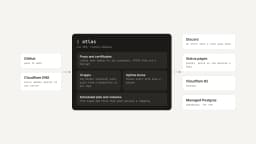
Atlas is what replaced it: one VPS that I run, where every app is a Docker container and a push to GitHub deploys it.
What runs on it
Fourteen apps, across three groups:
- Ruh Labs: the StudyMV study site, a shop and its staff app, the developer tools API, the company site and its status page.
- A suite of six internal apps for one organisation, plus their status page.
- This site.
Most are Next.js. This site was SvelteKit at the time, and the API and status pages are small Hono servers.
How a deploy works
- Each repo has a Dockerfile. I push to
main. - Dokploy, an open-source deployment panel on the server, gets the push from GitHub, builds the image and swaps the container.
- The proxy routes each domain to its container and gets an HTTPS certificate from Let's Encrypt.
Scheduled jobs that used to be the host's cron feature became scheduled tasks on the server. Files that must survive a redeploy, like uploads and the status pages' history, live on volumes.
Knowing when something breaks
I found out about the pause from a downtime status alert, sent by a monitor I'd set up a few days earlier. It only covered a couple of sites then. Now it covers all of them.
- Uptime Kuma checks every site once a minute and posts to Discord when one goes down or comes back.
- Two public status pages read the monitor's data and keep their own 90-day history. On the Ruh Labs one, each service is drawn as a palm frond with a leaflet per day.
What went wrong along the way
Moving off a platform shows you everything it was doing for you.
- Certificates need DNS first. A domain added before its DNS pointed at the server never got a certificate. The fix was to remove the domain and add it again once DNS had moved.
- A standalone Next.js build leaves files behind. The self-contained server doesn't include the
publicfolder or static assets. They have to be copied in next to it, and in a monorepo the file tracing has to start from the repo root. - Build-time surprises. Prisma wanted a database URL just to generate its client during install. Auth.js refused sign-ins behind the proxy until it was told to trust the host header.
- Secrets I couldn't read back. Values marked sensitive on the old host can be used there but never shown again, so a few keys had to be tracked down from other places.
- Node 26 has no Corepack. The first build of this site failed because the Dockerfile enabled pnpm through a tool that newer Node images no longer ship.
- A cached stylesheet made a redesign look broken. New HTML met an hour-old CSS file in the browser. Asset URLs now carry a content hash.
What it doesn't solve
- One server is one point of failure. If it goes down, everything does. The difference from before is that I'll know within a minute, and I can fix it myself.
- It's farther away than I wanted. The Singapore region was out of stock, so the server is in India, about 70 ms from the Maldives when I measured it.
- The databases haven't moved. They're still on managed Postgres. That's next, along with proper metrics.
Built with
Docker for every app, Dokploy for deploys with Traefik and Let's Encrypt underneath, Uptime Kuma for monitoring, Cloudflare for DNS and R2 for backups.